Glasses that work are three decisions made well: a frame that fits your face, a lens design that fits your prescription and your day, and measurements taken on you while you wear the frame. All three happen here, by an optician, with the lenses cut in our own lab. Bring a current prescription from any doctor, or have the exam here first.
A prescription is a set of numbers. Turning it into glasses you forget you are wearing depends on where the optical center of each lens sits in front of your pupil, how far the lens is from your eye, and the angle the frame holds it at. Those are measured on your face, in the frame you chose, and a millimeter off is enough to cause eye strain in a strong prescription or a progressive.
The frames here are chosen one line at a time rather than bought by the crate: independent makers from Japan, Denmark, and France next to the houses everyone knows, across a range of prices and face shapes. An optician helps you narrow it to frames that suit your prescription as well as your face, because a thick lens in a rimless frame or a progressive in a shallow one is a mistake you only discover at pickup.
Lenses are cut and edged in our own lab, checked against your prescription before you see them, and fitted on the day you collect. After that, adjustments are part of owning the glasses: come back whenever they stop sitting right.
Balmain, Cartier, Celine, Chanel, Dior, Fendi, Gucci, Loewe, Tom Ford, Ray-Ban, Oliver Peoples, Maui Jim. Alongside them the independents: Lindberg, Mykita, Jacques Marie Mage, Eyevan, Lapima, Movitra, T Henri. Try on as many as you like; nobody is on commission.
Single vision for one distance. Progressives for distance, screen, and reading in one lens with no line. Office or computer lenses tuned to desk distances. The optician matches the design to your prescription and the hours you spend at each distance.
Pupillary distance, the height of your eyes in the frame, the tilt and wrap of the front, and how far the lens sits from your eye. Each one goes into how the lens is made. Online orders guess these; a progressive made from a guess is the one people cannot adapt to.
Thinner high-index material for strong prescriptions, impact-resistant lenses for kids and sports, anti-reflective coating for night driving and screens, lenses that darken outdoors, polarized for the water. You hear what each one does for your eyes and your frame, then decide.
Lenses are edged to the frame in our lab and verified against the prescription before pickup. If a lens is off, it is remade before you ever wear it. You are told the turnaround for your lens and coating when you order.
At collection the frame is fitted to your face: temple curve, nose pads, level. Afterward, any time the glasses slip or sit crooked, bring them in and an optician resets them while you wait.
A new pair is not only for a new prescription. Any of these is reason enough.
Have your eyes examined here, or bring a current prescription from any optometrist or ophthalmologist. Prescriptions are valid for a set period; if yours has lapsed, an exam comes first so the lenses are made to numbers that are still true.
An optician narrows the wall to frames that suit your face, your prescription, and the lens design you need, then you take your time. A strong prescription or a progressive rules some frames out, and it is better to know that before you fall for one.
Design, material, and coatings, explained in terms of what you do all day. Most people need fewer upgrades than they expect, and some need one they had not heard of.
Taken on your face in the chosen frame: pupillary distance, fitting height, and the frame's angles. These are what make the lens sit where your eye looks through it.
You are called when the glasses are ready. At pickup the lenses are checked with you wearing them and the frame is adjusted to your face. Come back whenever it needs resetting.
Bring your prescription in any day, or call (310) 305-2950 and ask what we carry in your style.
Every lens has an optical center, and your eye has to look through it. Pupillary distance gets you close; fitting height, the frame's tilt, and the distance from lens to eye finish the job, and all four change with the frame you choose. Order the same prescription in two frames measured for one of them and the second pair will feel wrong in a way that is hard to name. This is the reason to buy glasses from the person who measures you.
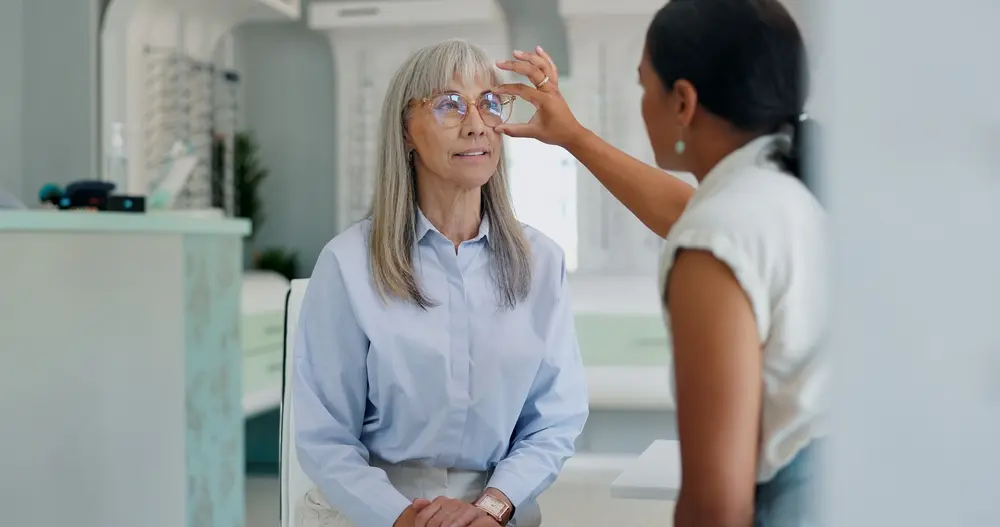
A progressive lens has a corridor of clear vision that narrows toward the reading zone, and where that corridor sits depends on the fitting height and the frame. Get it right and you forget the lens is there. Get it a few millimeters off and you tilt your head to read and the sides swim. Most people who say they could not adapt to progressives were wearing a pair that was never fitted.

Most vision plans give you a frame allowance and cover a basic lens, with upgrades such as thinner material or anti-reflective coating paid at a plan rate. The plans accepted are listed below. Call (310) 305-2950 with your plan name before you come in and the front desk will tell you what your benefit covers and when it renews.
An outside prescription is welcome with any plan. Bring the prescription, your vision plan card, and your current glasses so the optician can see what has worked for you.
Doctor of Optometry since 1994, with certificates in the treatment and management of ocular disease and of glaucoma.
Residency in pediatrics, vision therapy, and neuro-optometric rehabilitation. Glaucoma certified, licensed in California and Washington.
UC Berkeley Doctor of Optometry with a residency in ocular disease. Glaucoma and therapeutic pharmaceutical agent certified.
Office Hours
| Monday | 10:00am – 6:00pm |
| Tuesday | 10:00am – 6:00pm |
| Wednesday | 10:00am – 6:00pm |
| Thursday | 10:00am – 6:00pm |
| Friday | 10:00am – 6:00pm |
| Saturday | 10:00am – 6:00pm |
| Sunday | 11:00am – 4:00pm |
The place that measures you in the frame you are buying and makes the lenses to those measurements. An independent optical shop with an optician and its own lab does that; a website cannot. For a simple single-vision prescription the gap is small. For a strong prescription, astigmatism, or progressives, it is the difference between glasses you forget and glasses you fight.
Yes. Bring a current prescription from any optometrist or ophthalmologist and it is filled here the same way as one written in this office. If it has expired, or it is missing your pupillary distance, an exam or a measurement is done first so the lenses are made to the right numbers.
Some simple single-vision orders can be quick; progressives, high-index lenses, and most coatings are made to order and take longer. You are told the turnaround for your prescription and lens choice when you order, before you commit. If you need a pair fast, say so and the optician will tell you what is possible.
Often, yes, if the frame is in good condition and the hinges and rims will survive the old lenses coming out. The optician checks the frame first and says if it is a poor bet. Reglazing and repairs are covered on the eyeglass repair page.
The distance between the centers of your pupils, in millimeters. Lenses are made so their optical centers sit at that distance. If it is off, you look through the lens at an angle, which adds unintended prism and causes eye strain and headaches. It is measured here on your face, in the frame, along with the height of your eyes in it.
Progressives give distance, intermediate, and near in one lens with no visible line, and they are what most people over 40 end up in. Bifocals have a line and a jump between zones but a wider reading area, which some people prefer for a lot of close work. The optician will show you both; the fitting is what makes a progressive work.
Anti-reflective coating earns its place for almost everyone: less glare at night and on screens, and other people see your eyes instead of reflections. Lenses that darken outdoors suit people who move in and out all day. Polarized lenses are for sunglasses and the water. Blue-light filtering is a preference, not a need. You hear the case for each and decide.
Your plan sets an amount it pays toward a frame, and you pay the difference if the frame costs more. Lenses are covered at a basic level with upgrades at plan rates. The front desk checks your benefit before you choose, so you know the number while you are looking at the wall rather than at the register.
Balmain, Cartier, Celine, Chanel, Dior, Fendi, Gucci, Loewe, Tom Ford, Ray-Ban, Oliver Peoples, and Maui Jim, plus independent makers: Lindberg, Mykita, Jacques Marie Mage, Eyevan, Lapima, Movitra, and T Henri. The selection changes through the year. If you have a specific frame in mind, call (310) 305-2950 and ask before you come in.
Yes, in sunglass frames from the collection or in a frame you bring, with polarized, tinted, or photochromic lenses made to your prescription. A second pair in sunglasses is the most common add-on, and some vision plans allow a second-pair benefit.
Yes. Children’s frames are chosen for fit and durability, with impact-resistant lenses as the default, and adjustments through the year are part of the purchase, because a frame that fit in September will not fit in May.
Come back. A new progressive takes a week or two to adapt to, but headaches, swimming edges, or a reading zone you have to hunt for are fitting problems, and the optician rechecks the measurements and the lens against your prescription. A lens that was made wrong is remade.
Walk in any day to try frames at Modo Optometry in Marina del Rey, or call (310) 305-2950. Bring a current prescription or book an exam.